
How to Choose the Right Air Duct Cleaning Company in Miami
The right air duct cleaning company in Miami is one that owns truck-mounted negative-pressure equipment, sends the same technician who’ll be accountable for results, and inspects your system before quoting—not after collecting payment. Ask three operational questions before booking: who physically performs the work, what specific equipment they own (brand and suction CFM), and what’s included in writing. If any answer is vague, keep looking. If you’d rather skip the vetting process, Apex Air Duct Cleaning Service Miami offers free estimates—call (833) 628-3661.
Of the dozens of duct cleaning companies operating in Miami-Dade, fewer than a third own the truck-mounted equipment required to clean ductwork to NADCA’s minimum air velocity standard. Most will still show up with a shop vac, run it for an hour, and call it a cleaning. We’ve been called in after these jobs to do the work properly, and the homeowner pays twice. Here’s how to avoid that.
Question 1: Who Physically Does the Work?
This is the most important question, and it’s the one most Miami homeowners forget to ask. The person who answers your call is rarely the person who shows up.
There are three crew models in this market, and they produce very different outcomes:
- Owner-operated: The same person who built the company’s reputation arrives at your door, does the work, and answers for the results. Accountability is direct and personal. We’ve operated this way for 11 years because it’s the only model where the technician’s incentive aligns completely with the customer’s outcome.
- Franchise crews: Technicians are employees following a script. Some are excellent; many are new hires with minimal training. The owner is rarely on-site, and accountability flows through a corporate call center.
- Subcontracted crews: The company you called hires another company you’ve never vetted. These arrangements are common with low-bid platforms, and quality control is essentially nonexistent.
In Miami’s climate—where humidity drives microbial growth and salt air corrodes components—you want someone who recognizes what they’re seeing, not someone reading from a checklist for the first time. Ask directly: “Will the owner or a subcontractor perform the work?” If they hedge, that’s your answer.
Question 2: What Specific Equipment Do You Own?
“Professional equipment” means nothing without specifics. The industry has two legitimate cleaning methodologies, and the equipment required for each is completely different.
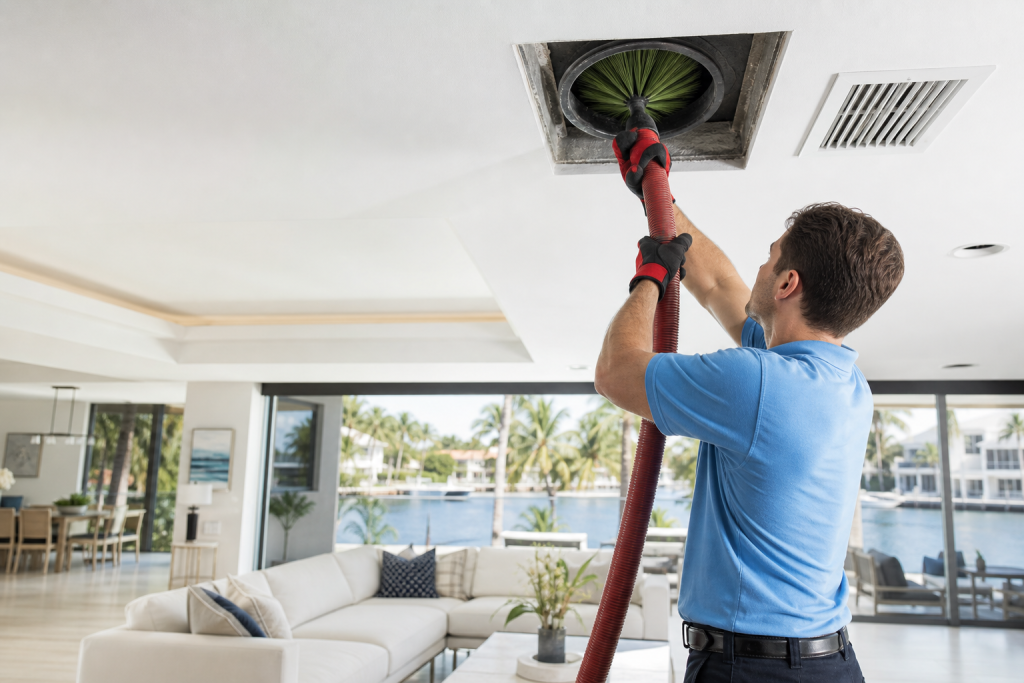
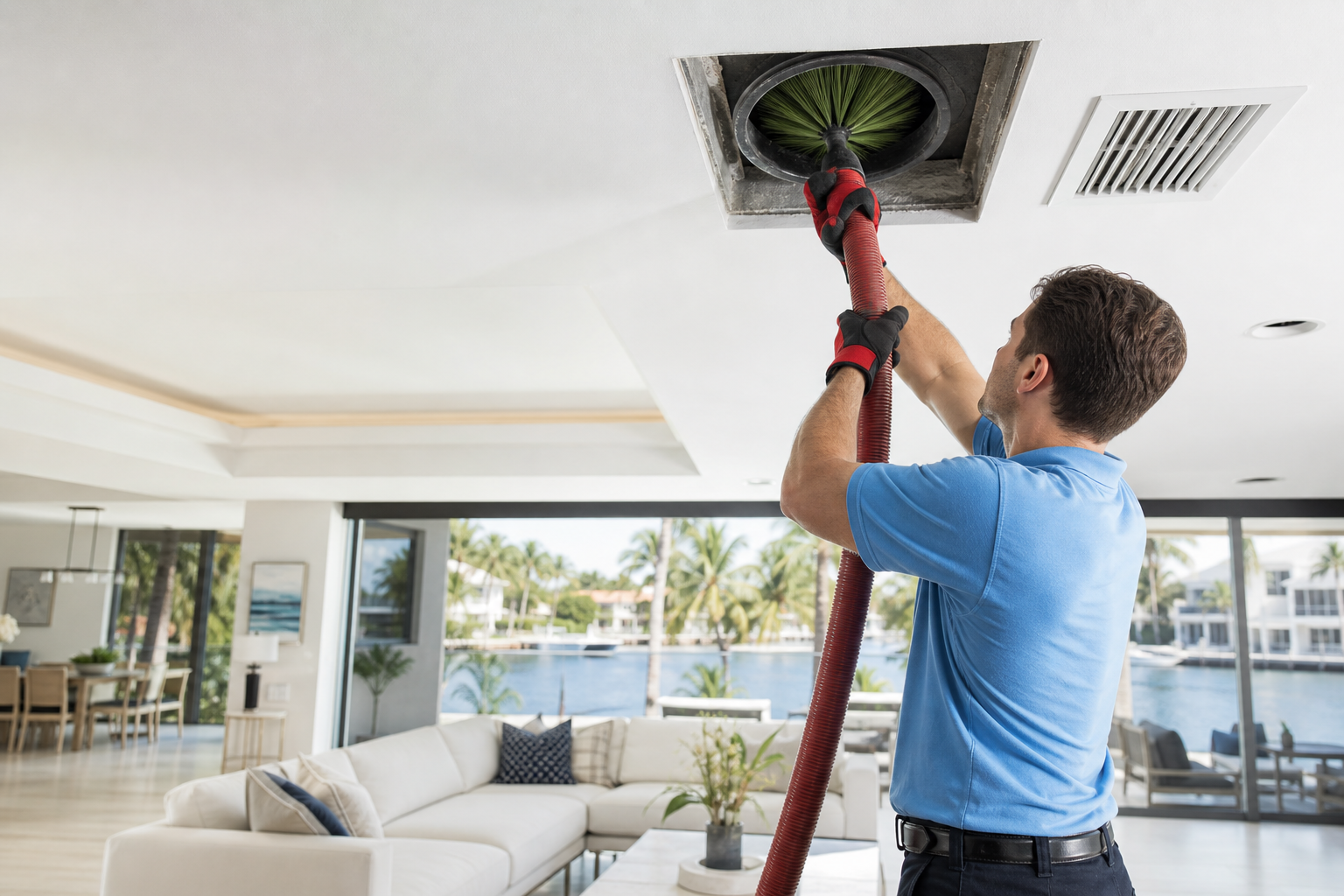
Rotary brush systems (contact cleaning): A spinning brush scrubs duct walls while a vacuum collects debris. For residential work, Rotobrush sets the standard—their brush-and-vacuum units are designed specifically for ductwork dimensions and material types. A genuine Rotobrush system runs $15,000–$25,000 depending on configuration. Many Miami operators use consumer-grade shop vacs with brush attachments purchased online for $200.
Negative air pressure systems: A large vacuum (typically Nikro or comparable) creates suction throughout the duct network while agitation tools loosen debris. NADCA’s minimum standard requires sufficient air velocity to maintain negative pressure across the entire system—something portable units cannot achieve. Truck-mounted Nikro systems pull 5,000+ CFM; a shop vac pulls 100–200 CFM.
Ask for the brand name and suction capacity in writing. If they say “commercial-grade” or “industrial-strength” without specifics, they’re describing marketing language, not equipment. We use both Rotobrush contact cleaning and Nikro negative-pressure systems, selecting the appropriate method based on duct material, contamination type, and system age.
Question 3: What’s Included in Writing Before Payment?
Any credible company in Miami will provide a written scope before work begins—not a verbal estimate, not a range, not “we’ll see when we get there.” The scope should specify:
- Number of supply and return vents to be cleaned
- Whether the main trunk lines are included (many low quotes exclude these)
- Access points to be created and sealed
- Whether the HVAC blower and coil are included
- Post-cleaning verification method (visual inspection, photo documentation, or particle count)
We provide this scope during our walkthrough, before any commitment. A company that quotes over the phone without asking about your duct material (flex, fiberglass, or metal), home age, or last service date is guessing—and their guess will either be inflated to cover uncertainty, or low enough to win the job before adding charges on-site.
When to call a pro: If your ducts haven’t been cleaned in 5+ years, you notice dust accumulation on vents within weeks of cleaning, or your HVAC runs constantly in Miami’s summer without cooling effectively, the system likely has significant buildup that requires professional equipment. Call (833) 628-3661 for a free walkthrough and written scope.
Why Star Ratings Mislead in This Industry
Google ratings are a poor quality filter for duct cleaning because the customer rarely knows whether the job was done correctly. A technician who arrives on time, wears boot covers, and leaves the house smelling like lemon sanitizer gets five stars—even if the ducts remain clogged.
Here’s what to look for instead:
- Technical specificity in reviews: Look for phrases like “showed me the before/after photos,” “cleaned the main trunk,” or “found a disconnected return in the attic.” These indicate the customer witnessed actual work, not just a pleasant interaction.
- Volume at high rating: A handful of perfect reviews is easy to manufacture. 867 verified reviews averaging 4.9 stars across 11 years indicates consistent performance under scrutiny. That’s our record, and it’s rare in this market.
- Owner response patterns: Does the owner respond to negative reviews personally, with specifics? Or do they use generic corporate language? Accountability in public predicts accountability in your home.
We pulled one out of a garage over in Norland last month where the previous “cleaning” company had never even opened the attic access panel—the homeowner found our card tucked behind it, still sealed, three years after the service date. The five-star review from that job was still live.
How to Verify Credentials in 10 Minutes
Three credentials matter for duct cleaning in Miami, and each takes under three minutes to check:
NADCA certification: Visit nadca.com and search the company name. Certification requires technicians to pass an exam on HVAC system cleaning, not just duct vacuuming. Note: NADCA certifies individuals, not companies—a company claiming “NADCA certified” should name the specific certified technician who’ll perform your work.
Florida contractor license: Search myfloridalicense.com. Duct cleaning that involves system modification requires a licensed contractor. The license number should match the business name; if it belongs to a different entity, you’re dealing with a subcontractor arrangement.
Insurance verification: Request a certificate of insurance (COI) naming you as additional insured. This takes 30 seconds for a legitimate company to produce and prevents you from absorbing liability if a technician is injured on your property or damages your system.
We carry full coverage and provide COIs on request—no hesitation, no delay. A company that treats this as an inconvenience has something to hide.
The Walkthrough: What a Credible Technician Does Before Quoting
A proper duct cleaning quote requires physical inspection. Over-the-phone estimates are educated guesses at best, bait-and-switch setups at worst. Here’s what we do during a Miami home walkthrough:
- Count and inspect all vents: Supply and return counts vary dramatically in Miami’s mix of 1950s ranch homes, 1980s townhouses, and new construction with multi-zone systems.
- Identify duct material: Flex duct, fiberglass duct board, and galvanized steel each require different cleaning methods and agitation intensity. Using a rotary brush too aggressively on old flex duct can tear it.
- Check system age and service history: A 25-year-old system with no prior cleaning requires different handling than a 5-year-old system on a maintenance schedule.
- Inspect the air handler: The blower and evaporator coil condition determine whether cleaning alone will improve airflow or if additional service is needed.
- Document with photos: Before-and-after documentation protects both parties and provides proof of work completed.
Any company that quotes without this information is either overcharging to cover uncertainty, or underquoting to win the job before adding charges. We don’t quote until we’ve walked the system—it’s non-negotiable, and it’s why our estimates are accurate to the dollar.
Related services in Miami: If your system needs more than cleaning, we handle HVAC cleaning, duct repair and sealing, and air quality sanitizing in one visit—no coordinating multiple contractors. We also provide dryer vent cleaning in Norland and throughout Miami-Dade.
The Bottom Line
Choosing a duct cleaner in Miami comes down to operational verification, not marketing polish. Ask who performs the work, what equipment they own by brand and specification, and what the written scope includes. Verify credentials independently. Insist on a walkthrough before any quote. The companies that survive this screening are the ones that have nothing to hide—and they’re rarely the cheapest option, because proper equipment and accountable labor have real costs.
We’ve built Apex Air Duct Cleaning Service Miami on this transparency for 11 years. Owner-operated and owner-present, with professional-grade Rotobrush and Nikro equipment, 867 jobs reviewed at 4.9 stars, and full-scope service from cleaning to repair to sanitizing—handled in one visit. If you’re in Miami and want a free walkthrough with a written, binding estimate, call (833) 628-3661.
Frequently Asked Questions
Residential duct cleaning in Miami typically ranges from $300 to $800 for a complete system, depending on home size, duct material, and contamination level. Quotes below $250 usually indicate incomplete scope or inadequate equipment. Call (833) 628-3661 for an exact quote—our estimates are free and binding after walkthrough.
No—Florida has no licensing requirement specific to duct cleaning, which is precisely why the market is flooded with underqualified operators. NADCA certification is voluntary and indicates a technician has passed rigorous exams on HVAC system cleaning standards. We recommend verifying NADCA certification at nadca.com before booking any company.
Every 3 to 5 years for typical Miami homes, and every 2 to 3 years if you have pets, allergies, or live near construction or agricultural activity. Miami’s high humidity accelerates microbial growth in ductwork, and salt air corrodes metal components—both factors shorten the effective cleaning interval compared to drier climates. Call (833) 628-3661 if you’re unsure whether your system is due.
Duct cleaning addresses the distribution network—supply and return vents, trunk lines, and branch ducts. HVAC cleaning includes the air handler components: blower motor, evaporator coil, and condensate pan. A company that cleans ducts without inspecting the air handler is addressing symptoms while ignoring a major source of contamination. We evaluate both during every walkthrough. Learn more about our HVAC cleaning services in Norland and surrounding Miami areas.
Written by Michael Brown, Owner & Lead Technician at Apex Air Duct Cleaning Service Miami, serving Miami since 2015.
Need Air Duct Cleaning Help?
Call Apex Air Duct Cleaning Service Miami — licensed & insured, here with fast after-hours help in Miami.
(833) 628-3661